
































Quick Summary: 68% of US Google searches now end without a click, and this post shows you exactly how far zero-click search has gone and what it means for your organic traffic.
The Full Story (Less than 30 seconds):
- US zero-click rates have climbed from 45% in 2016 to 68.0% in 2026.
- Only 231 of every 1,000 US searches now reach the open web, down from 360 in 2024.
- AI Overviews cut outbound organic clicks by 39.8%, and position one loses 58% of its click-through rate.
- Google AI Mode is far worse, with a 93% zero-click rate.
- Being cited inside an AI Overview earns 120% more clicks than ranking on page one without a citation.
The key takeaway here? Rankings and clicks are slowly being replaced with citations and conversions.
Watch out: Zero-click rates vary hugely by query type, so a blended average will mislead you about your own keywords.
68% of US Google searches and 69.5% of UK Google searches are now zero-click.
This is up from just a 49% zero-click rate in 2019.
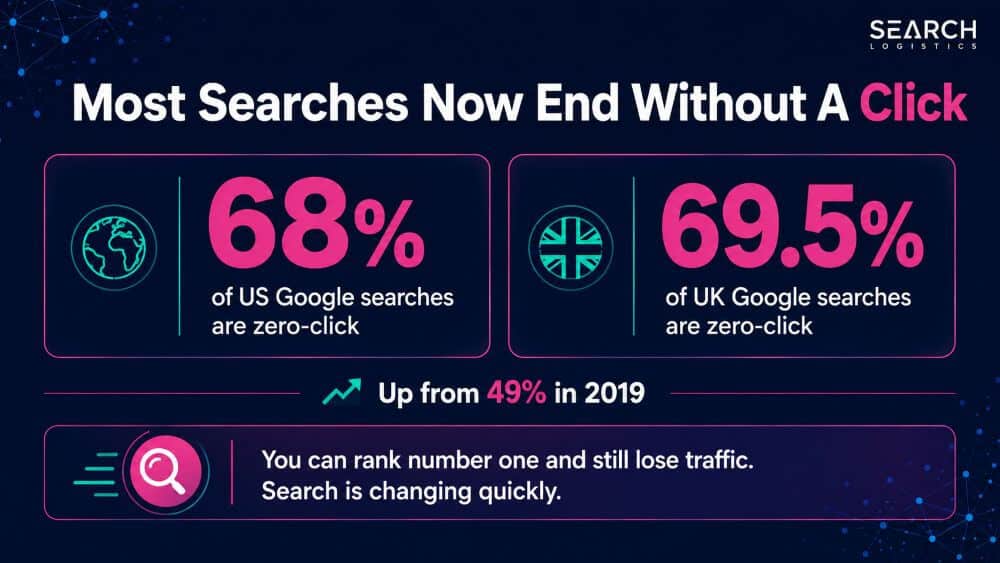
Search is changing quickly.
Google AI Overviews and AI search platforms like ChatGPT and Perplexity are completely changing the way that people search online.
And they’re able to answer the vast majority of questions without referring any visitors to your site.
Here’s the problem:
Most SEOs and marketers still don’t know how to adapt to these changes.
So I gathered the latest 2026 zero-click statistics and put them all into one place to answer that question.
These statistics will show you what types of searches are now being answered by AI, how zero-click searches have evolved and what to expect in the future.
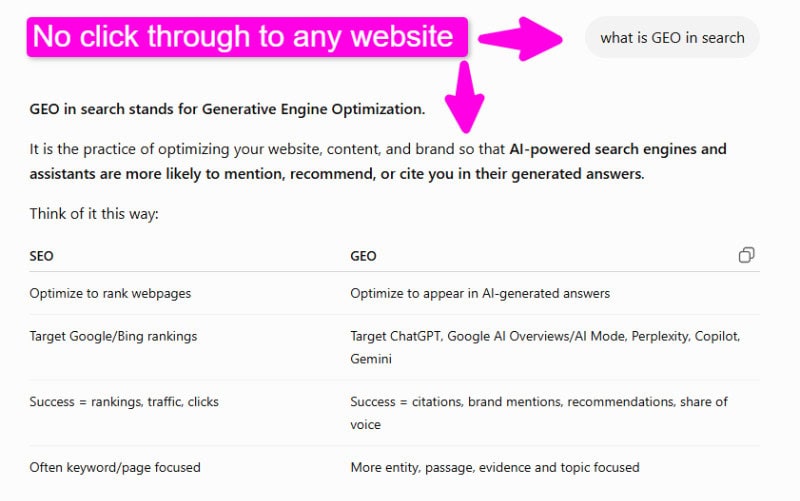

What Will I Learn?
Key Zero-Click Search Statistics
These are the most important zero-click search statistics you need to know:
- 68.0% of US Google searches now end without a click
- Only 231 of every 1,000 searches made now reach the open web
- AI Overviews cause a 39.8% drop in organic clicks through to websites
- The number 1 ranking results on Google lose 58% of their clicks on keywords that show an AI Overview
- Between 92% and 94% of Google AI Mode queries end with no click to a website
- Just 1% of users click a link that’s inside a Google AI Overview
- AI Overviews appear on 20.5% of all search engine results pages and 57.9% of all question searches
- The UK has the highest zero-click rate of any major search market at 69.5%
- Only 0.34% of Google searches use AI Mode in 2026
- Google AI Mode has 1 billion monthly users and Google AI Overviews reach 2.5 billion people
- Being cited in an AI Overview increases clicks by 120% versus ranking on the first page but not being cited
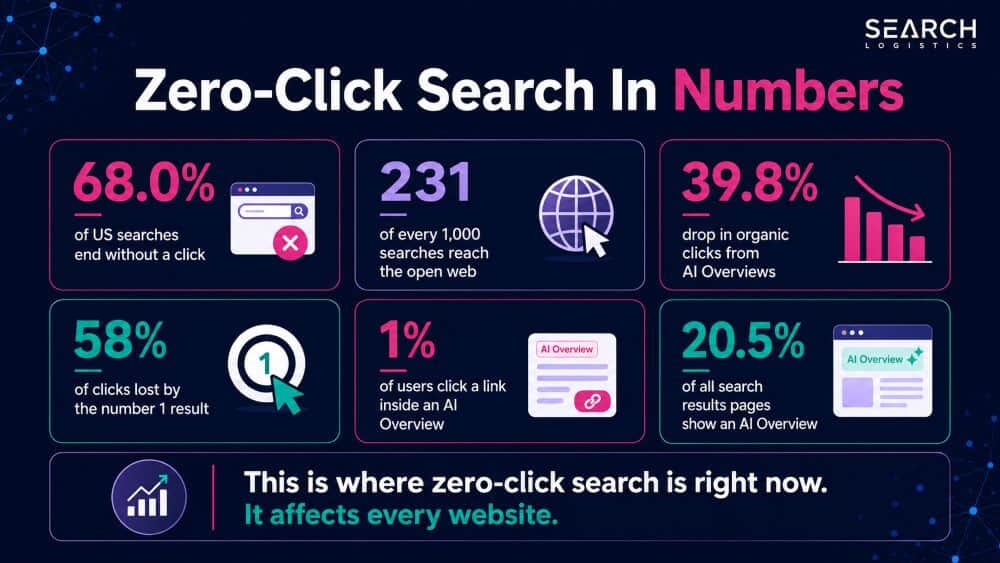
These key statistics give you a glimpse of where zero-click search is right now and how it affects every website. Let’s get into the details.
How Common Are Zero-Click Searches?
Zero-click searches are very common and now account for the majority of all searches online.
This is primarily due to AI search tools such as Google AI Overviews, ChatGPT and Perplexity.
What percentage of Google searches are zero-click in 2026?
68% of US Google searches now end with no click to any site.
That is up from 60.45% back in 2024, with a net rise of 7.6 percentage points in the last two years.
Put simply: Only 1 out of 3 searches now sends traffic to a website.
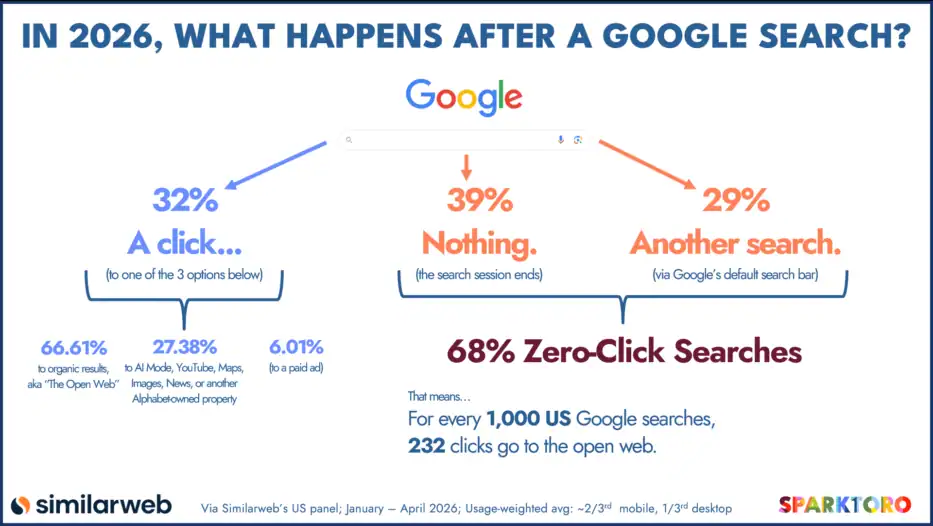
SparkToro has called this the “fastest acceleration in zero-click searches” since they started tracking.
And that’s not all…
The 68% reported figure is most likely to be on the low side of zero-click estimations.
Why?
The click-stream data used to track zero-click searches can only be seen in searches made on a desktop browser.
About 60% of all searches are made on a browser app on mobile devices.
Google leans even heavier on zero-click features in their browser apps, so it’s likely that the zero-click figure is actually higher.
Here’s a breakdown of how much zero-click searches have increased over the last 10 years:
| Year | US zero-click rate | Data panel |
|---|---|---|
| 2016 | 45% | Jumpshot (clickstream) |
| 2019 | 49% | Jumpshot (clickstream) |
| 2024 | 60.45% | Datos, now Semrush |
| 2026 | 68.0% | Similarweb, via SparkToro |
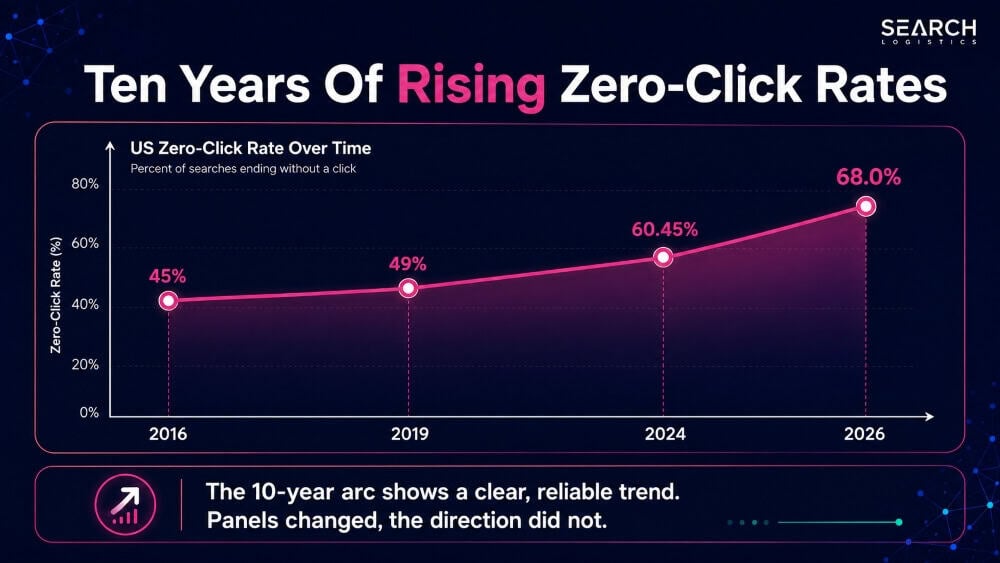
Note: Data sets and panels change across the years (Jumpshot, then Datos, then Similarweb). This means that year-to-year jumps aren’t as accurate, but the 10-year arc shows a clear, reliable trend.
How has the zero-click rate changed over time?
US zero-click rates have climbed from 45% in 2016 to 68.0% in 2026.
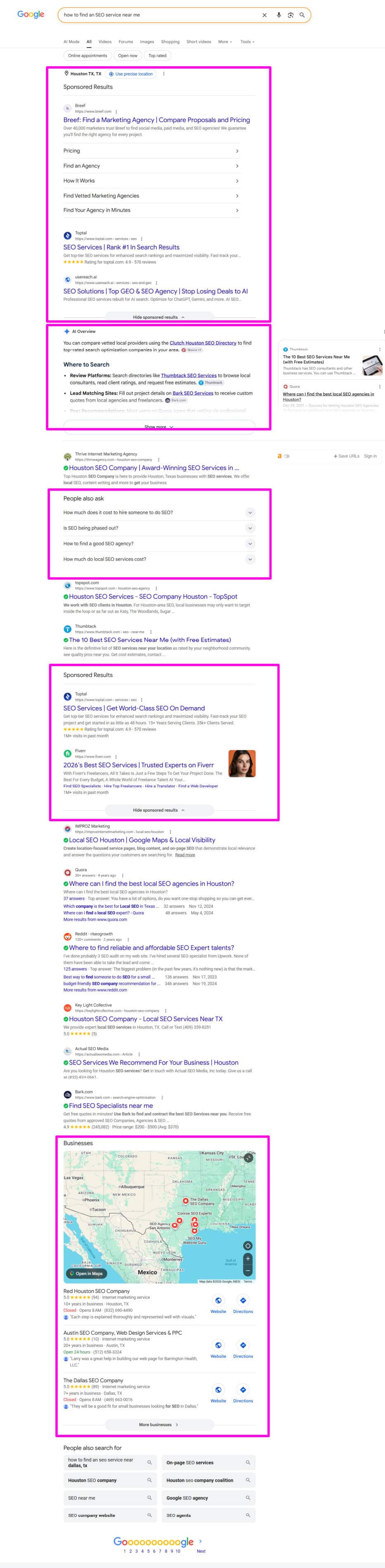
This is largely due to Google’s shifting away from providing links for users to click on to answering user searches directly in the search engine results pages.
Google’s goal has always been to answer as many searches as possible without the user needing to click through to a website.
And generative AI search has only accelerated that change.
True generative AI search was launched in 2022, but didn’t really get traction until early 2023. Google AI Overviews launched in May of 2024.
But you can already see the impact of AI over the last 3-4 years and how it’s changing search as an organic traffic source.
The biggest difference to take note of is that from 2016 to 2019, zero-click searches online increased by 4 percentage points.
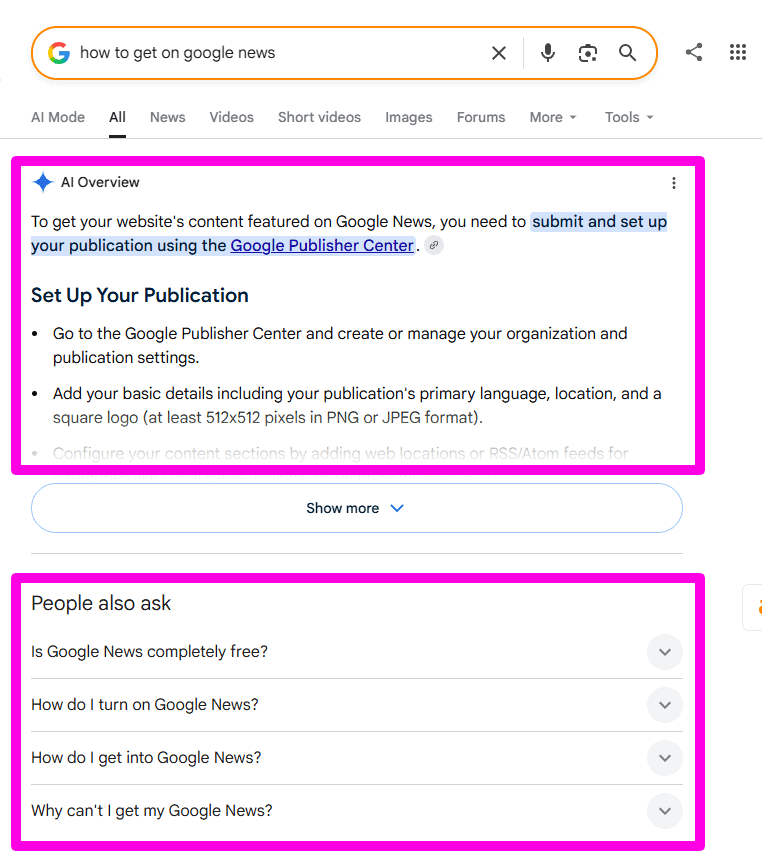
This was largely driven by SERP features such as:
- Featured snippets
- Knowledge panels
- Local map packs
- People Also Ask boxes
But from 2019 to 2024, it was over 11 percentage points. And now in 2026 it’s increased by 8 percentage points in just two years.
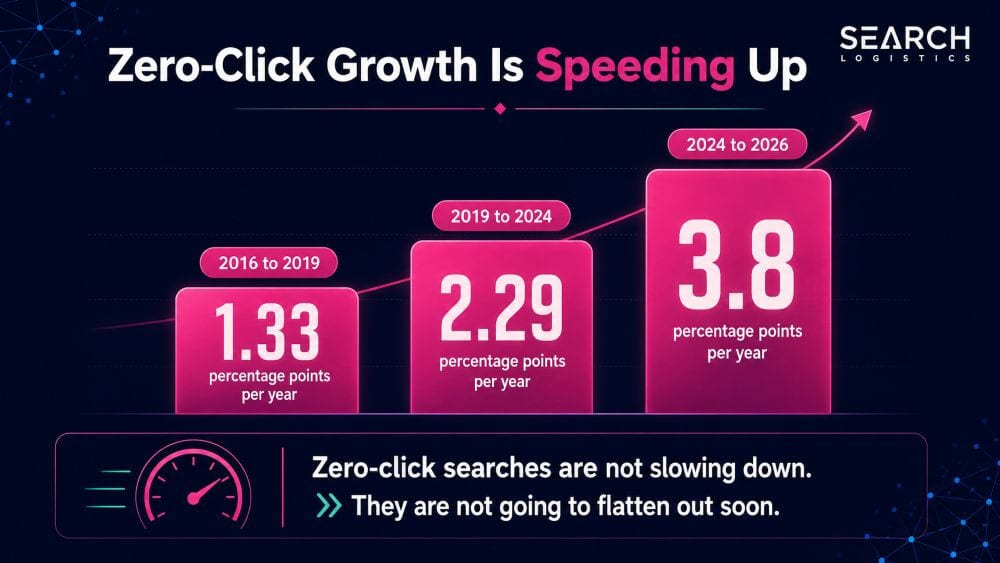
That means the average zero-click increase by year was:
- 2016 to 2019: 1.33 percentage points per year
- 2019 to 2024: 2.29 percentage points per year
- 2024 to 2026: 3.8 percentage points per year
But what does all this really mean?
Zero-click searches aren’t slowing down. In fact, they are speeding up. And the data seems to show that they aren’t going to flatten out anytime soon.
If you run a business that relies solely on organic search traffic, you need to start understanding how AI is changing the search landscape.
Here’s how to think of it:
Since the introduction of featured snippets in 2014, Google has been teaching people they don’t need to click to get their answer.
The issue was that Google could never truly answer all queries…
Until now with AI.
Between 2024 and 2026, the share of Google searches that resulted in at least one click fell by 9.51 percentage points, with a 22.9% relative decline overall.
But the number of searches that were followed by an additional Google search increased by 7.2 percentage points from 2024 to 2026.
What does that mean?
Google has managed to increasingly keep users within their own search experience without sending as much traffic to websites. And users that don’t click tend to make follow-up searches.
That’s a win-win for Google.
Zero-Click Search Rates By Country
Zero-click search rates vary significantly by region and country depending on how users gather information.
The table below shows the zero-click percentages broken down by each country:
| Country | Zero-click rate | Open-web clicks per 1,000 searches |
|---|---|---|
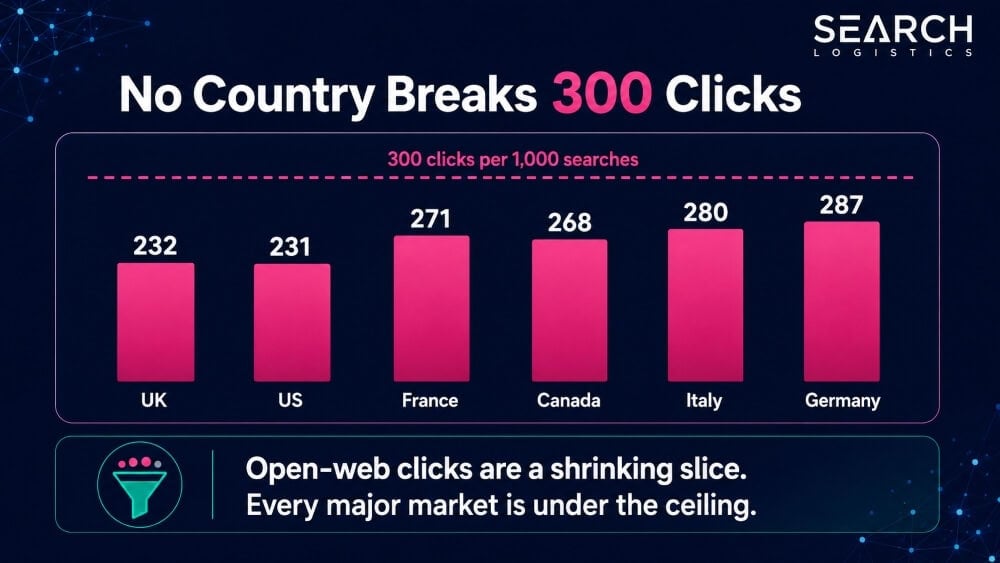
| UK | 69.5% | 232 |
| US | 68.0% | 231 |
| France | 65.3% | 271 |
| Canada | 63.8% | 268 |
| Italy | 63.4% | 280 |
| Germany | 62.1% | 287 |
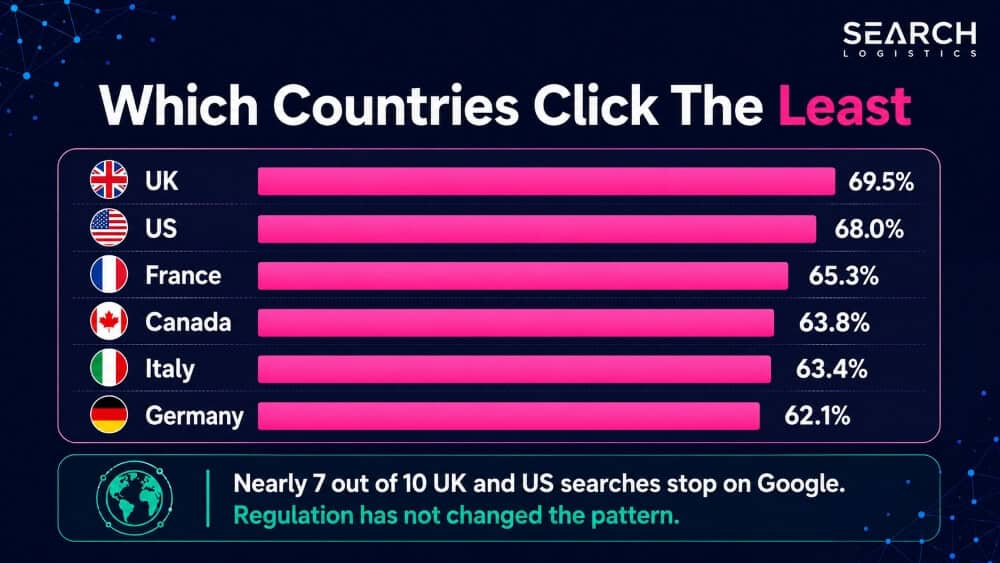
The zero-click rate is the share of searches that end without anyone clicking a result. So in the UK and US, nearly 7 out of 10 searches stop right there on Google.
The open-web clicks per 1,000 searches count how many searches in every thousand send an organic click out to a normal, non-Google website.
That’s why the two columns don’t necessarily add up.
The searches in between are the ones where someone clicked, but on a Google property like YouTube, Google Maps, or a paid Google ad.
Which country has the highest zero-click rate?
The UK has the highest zero-click search rate, with 69.5% of Google searches ending without a click to a website.
The US comes in close with the second-highest zero-click rate at 68%. Germany has the lowest zero-click rate of the top 6 countries at 62.1%.
The big takeaway here is that none of the primary countries has more than 300 clicks per 1,000 searches.
I’ve seen people speculating online that organic search in EU countries has been less affected by AI Overviews and AI Mode because of regulation.
But the data pokes a big hole in this speculation.
Why?
France and Italy are just 3-6% behind the UK and US in terms of zero-click rate. And Canada sits right in the middle of all the EU countries.
Even with tighter regulations and a higher anti-AI sentiment, EU countries have a very similar zero-click rate to the UK, US and Canada.
Zero-Click Rates By Industry
What industries have the highest zero-click rates?
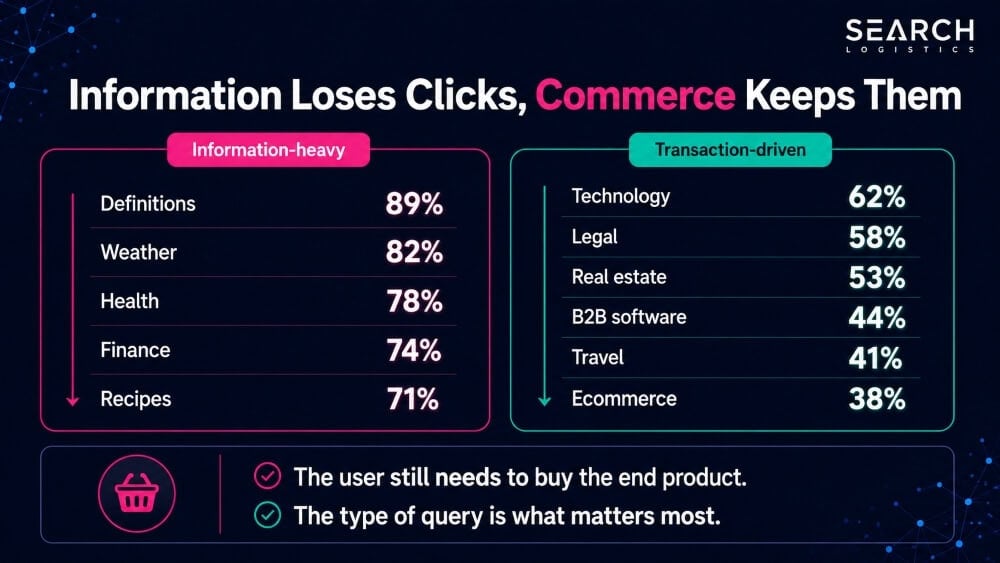
Definitions have the highest zero-click rate at 89%, followed closely by Weather searches that have a zero-click rate of 82%.
Here’s the full breakdown of zero-click rates by industry:
| Industry | Average Zero-Click Rate |
|---|---|
| Definitions | 89% |
| Weather | 82% |
| Health | 78% |
| Finance | 74% |
| Recipes | 71% |
| Technology | 62% |
| Legal | 58% |
| Real estate | 53% |
| B2B software | 44% |
| Travel | 41% |
| Ecommerce | 38% |
See the difference?
The top 5 industries with the highest zero-click rates (Definitions, Weather, Health, Finance, Recipes) are information-heavy industries.
The queries that users type in are usually about information issues they’re facing.
It makes sense that AI can answer these queries without the user needing to click through to an external site.
But the bottom 6 industries…
They’re more transaction/commercial driven industries. The user still needs to buy the end product/service to solve their problem at the end of the day.
Keep this in mind when choosing topics to target.
Remember:
These are all averages. An informational query in the B2B software industry is still going to trigger an AI Overview most of the time.
The type of query is what matters most.

Where Do The Clicks Actually Go?
Only about 1 in 3 Google searches now produce a meaningful click.
Here’s where all those surviving clicks actually go.
Where do the clicks go when someone actually clicks?
Only about 231 of every 1,000 US Google searches reach the open web. This is down from 360 in 2024.
When someone does click, roughly 66% goes to outside websites and about 27% stays directly inside Google properties.
This includes things like:
- Google Maps
- YouTube
- Google Images
- AI Mode
And more. About 6% of all clicks now go directly to Google paid ads.
Here’s a breakdown of where each click goes:
| Destination of the click | Share of clicks |
|---|---|
| Open web (external sites) | 66.61% |
| Google properties (AI Mode, YouTube, Maps, Images) | 27.38% |
| Google paid ads | 6.01% |
The trend here is pretty clear…
Open-web clicks in general are dropping very quickly. And of the clicks that do come through, Google is able to keep roughly ⅓ of them within its own ecosystem.
The open web is left competing for a shrinking slice of what’s left over.
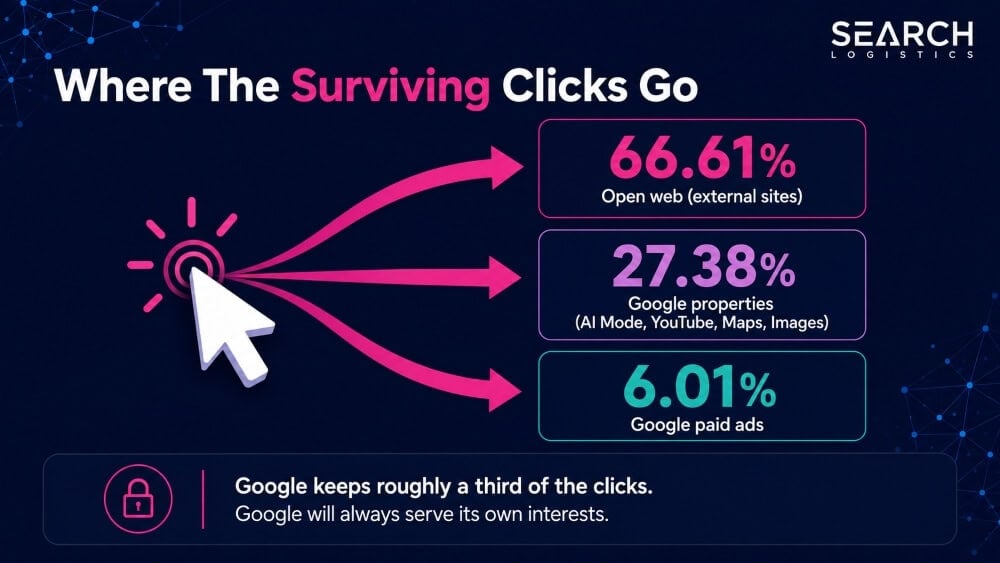
The most important thing to keep in mind is that Google will always serve its own interests. Every AI search platform is doing the same.
But don’t let these SEO statistics scare you.
Search is changing very quickly, and there is now less organic traffic flowing to external websites than ever before.
But here’s what you need to remember…
More people are searching than ever before. And AI doesn’t own the end product or service.
As long as you have what people want to buy, search will always be a valuable traffic source for you.The thing that changes is how people search and the metrics you use to measure it.
How much have clicks dropped because of AI?
Informational queries that AI can easily and quickly answer have been impacted the most by AI search.
But every type of query has been affected by AI search in some way.
Do AI Overviews reduce clicks?
Yes, Google AI Overviews significantly reduce clicks to websites.
Research shows that a randomised experiment found that outbound organic clicks decreased by 39.8% when an AI Overview appears.
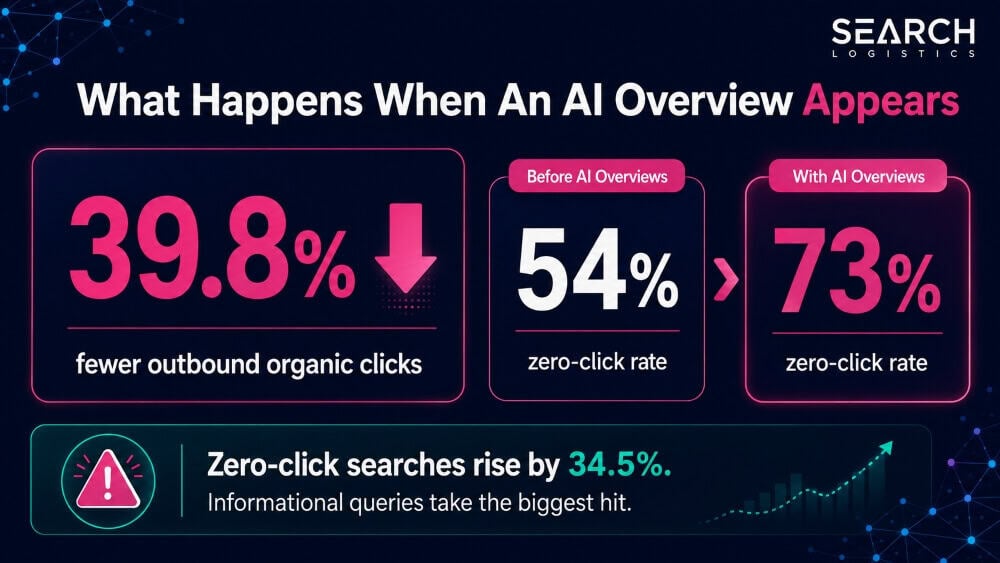
Zero-click searches also rise by 34.5% when an AI Overview appears for the search. Zero-click searches were at 54% before AI Overviews and are now up to 73% with AI Overviews.
The big thing?
There is no measurable change to user satisfaction.
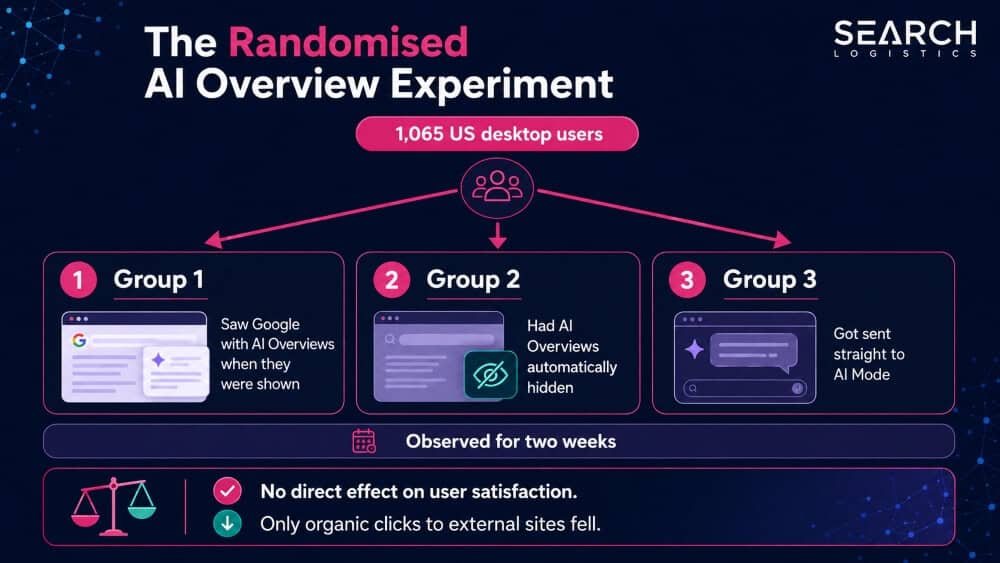
Saharsh Agarwal (Indian School of Business) and Ananya Sen (Carnegie Mellon) ran an experiment to test user satisfaction.
They built a Chrome extension and split 1,065 US desktop users into three random groups:
- The first group saw Google with AI Overviews when they were shown
- The second group had AI Overviews automatically hidden
- The third group got sent straight to AI Mode
Saharsh and Ananya then observed how each group acted as they normally used Google search for two weeks.
The result?
They found that removing AI Overviews from the SERPs didn’t make users less satisfied with Google. They also found that adding AI Overviews didn’t make them more satisfied.
Put simply: adding or removing Google AI Overviews had no direct effect on user satisfaction.
And that’s not all…
The research also found that while AI Overviews reduced organic clicks to external sites, they didn’t impact sponsored clicks or overall search frequency.
Note: This study hasn’t been peer-reviewed yet.
But the study is similar to what other research has found…
AI Overviews really only affect organic clicks to external websites, especially for informational-based queries that AI can easily answer.
How much do AI Overviews reduce click-through rate?
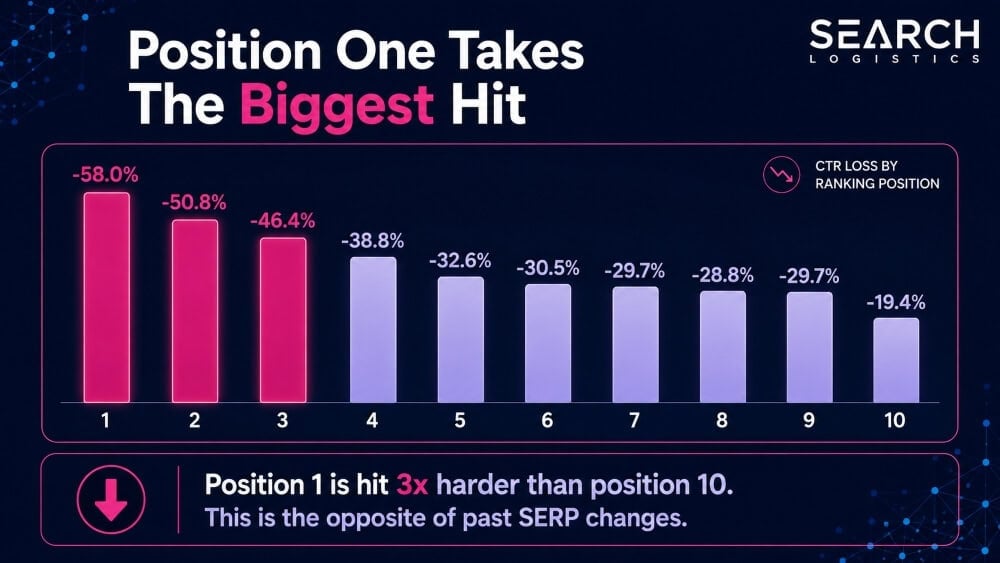
The number 1 ranking result on Google loses 58% of its click-through rate on keywords that show an AI Overview.
This is up from 34.5% in April 2025.
What’s interesting is that the number 1 ranking position takes the biggest hit.
Here’s a breakdown of how CTR is impacted when an AI Overview shows based on the ranking position:
| Ranking position | CTR impact when an AI Overview is present |
|---|---|
| 1 | -58.0% |
| 2 | -50.8% |
| 3 | -46.4% |
| 4 | -38.8% |
| 5 | -32.6% |
| 6 | -30.5% |
| 7 | -29.7% |
| 8 | -28.8% |
| 9 | -29.7% |
| 10 | -19.4% |
This is very different from previous updates or changes that Google has made to the SERPs.
In the past, it’s ranking positions 4 to 10 that usually take the biggest hit when changes are made to the search engine results pages.
But AI Overviews hurt the CTR of ranking positions 1 to 3 significantly more than any other.
In fact, ranking position 1’s click-through rate is reduced 2x more than ranking position 9 and 3x more than position 10.
Crazy, right?
All the credible studies done on AI Overviews and Zero-click results show the same trend…
AI Overviews significantly reduce organic traffic and click-through rates to external websites.
While the trend is the same, the results have not necessarily been the same.
Let me explain:
There have been 5 major studies on the impact of AI Overviews. They all have similar but different numbers.
Here’s a breakdown of each major research type done on Google AI Overviews:
| Source (date) | What it measures | Reported impact | Method |
|---|---|---|---|
| Agarwal & Sen (Apr 2026, rev Jun 2026) [S3] | Outbound organic clicks | down 39.8% | Randomised experiment (causal) |
| Ahrefs (Feb 2026) [S4] | Position-one CTR, AIO keywords | down 58% | 300k keywords, GSC CTR |
| Pew Research (Jul 2025) [S19] | Per-session click probability | 8% vs 15% | 68,879 real searches |
| Seer Interactive (2025 to 2026) [S20] | Organic CTR | down 49% to 65% | Brand-level GSC series |
| Authoritas (2025) [S21] | Organic clicks | down 47.5% | SERP analysis |
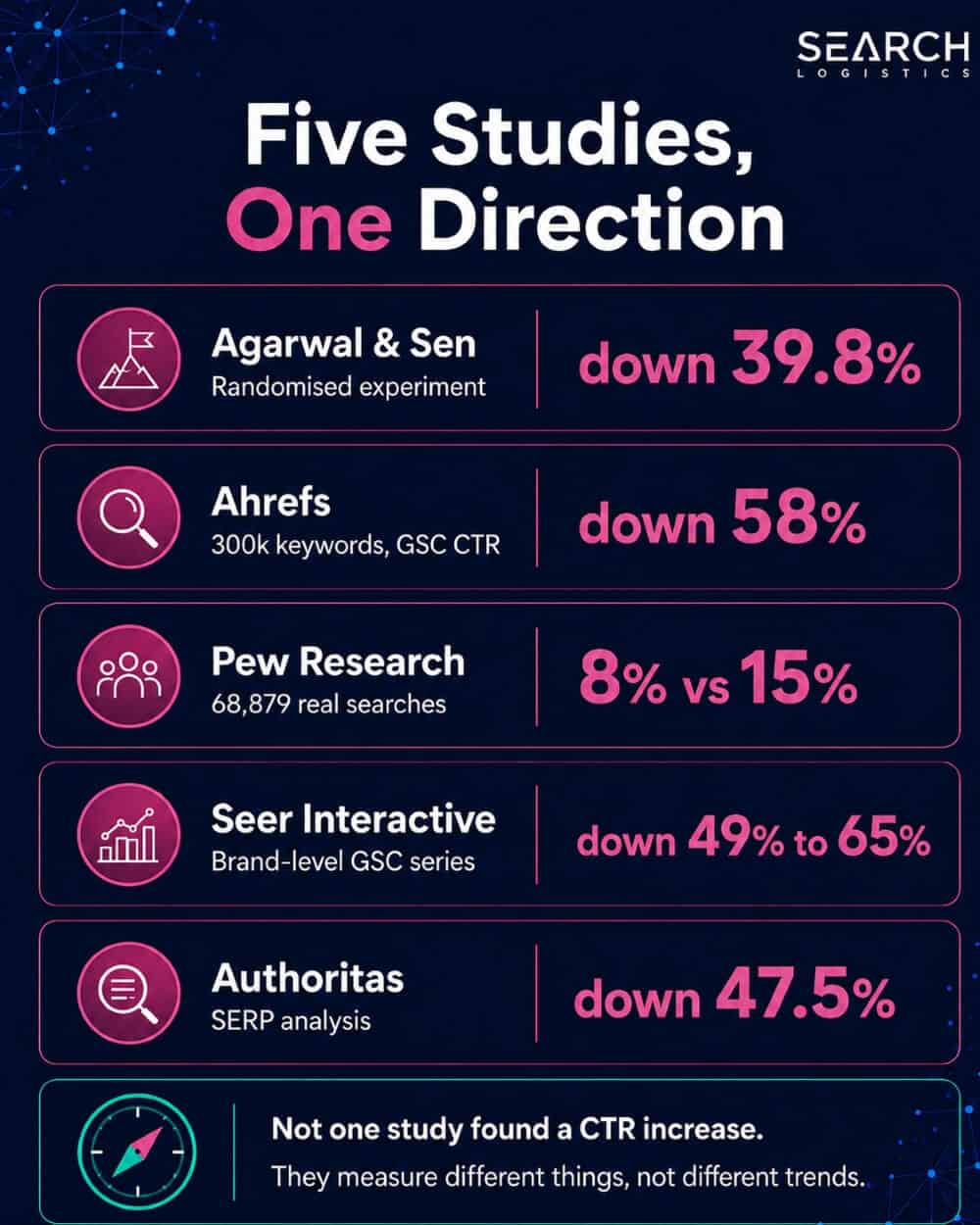
By lining up all these studies next to each other, you’ll notice that the data isn’t the same. One study says 39.8%, and another says 65%.
And there’s a reason for that…
Why does each study not have the same conclusion?
The reason that each study doesn’t have the same conclusion is that their focus is on slightly different things.
Let me explain:
- Agarwal and Sen’s research focuses on the cause and effect of a randomised test
- Ahrefs measures the top-ranking results’ CTR on AI Overview keywords
- Pew Research measures how often real users click any result during a full browsing session
- Seer Interactive measures organic click-through rate at a brand level
- Authoritas measures organic clicks across a large sample of search results
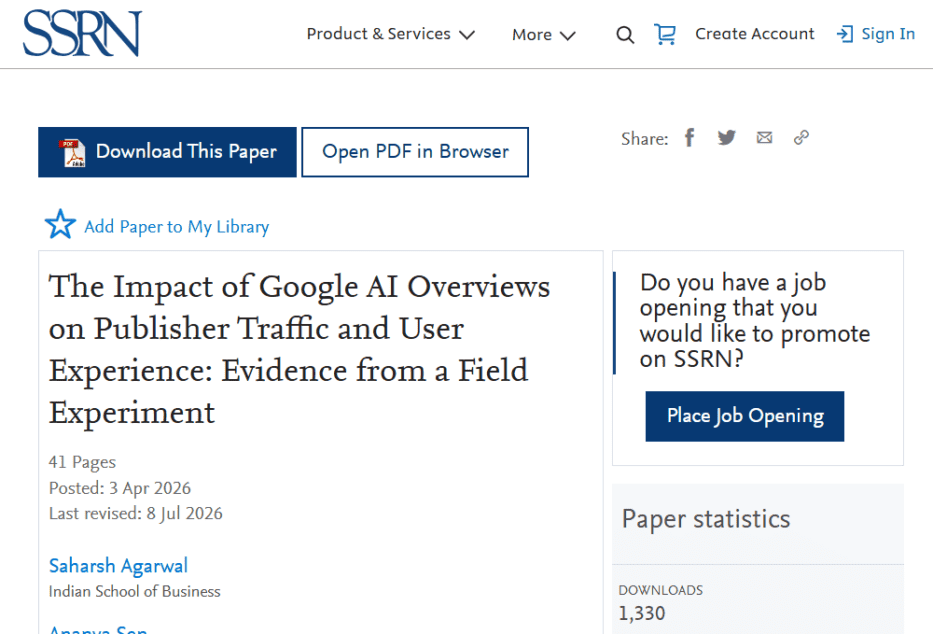
And that’s why they ultimately come to different conclusions.
None of the studies are wrong – they just measure the impact of AI Overviews in a different way.
So how can you use this data for your own business?
Even though they measure slightly different things, the results are actually closer than they first appear.
What can we take away from each of these studies?
Here’s what the analysis from the SearchLogistics team found:
AI Overviews have reduced organic click-through rates to websites by 39.8% to 65%. Not a single study has found that they have increased CTR in any way.
The reality is that users are now getting most of their answers in the SERPs and don’t need to click through to a website.
But here’s what stood out most when we measured all the results…
When you take the average results, AI Overviews reduce clicks to your website by about 50%.
In other words…
For every 10 clicks that your page used to get from searches, you’re now getting 5 when an AI Overview is present.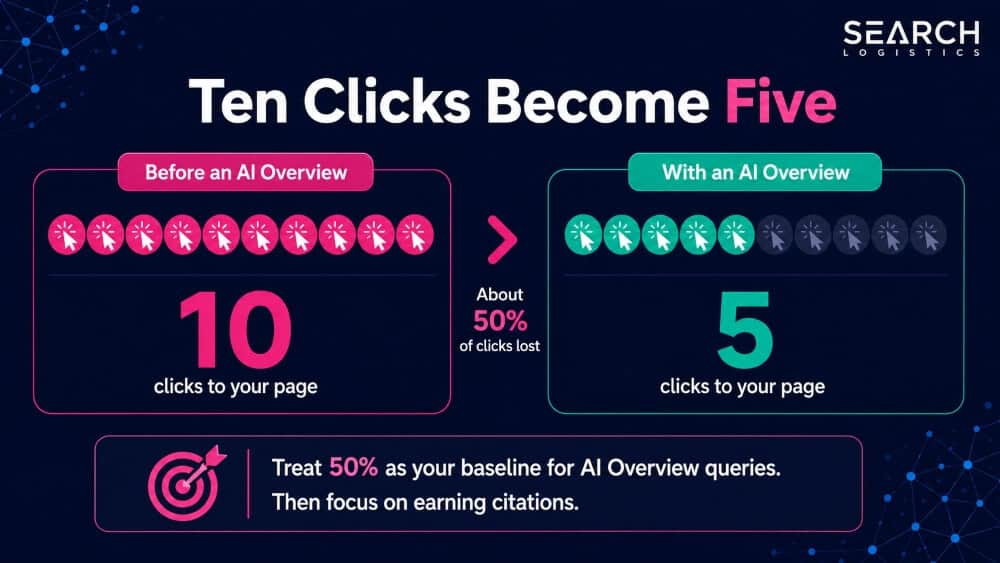
Here’s the takeaway:
Treat the 50% traffic loss as the baseline for any new search query you’re targeting today that already triggers an AI Overview.
Then focus on earning citations in AI Overviews and other AI search platforms, such as ChatGPT and Perplexity.
Make sure that you’re actively tracking AI results and focusing more on conversions instead of organic traffic. That’s what matters most.
This focus will help you create a stronger SEO strategy that actually helps you accomplish your business goals.
How much traffic do AI Overviews actually cost?
Pew Research tracked real user browsing time instead of just using estimates from tools.
They looked at tracked data from 68,879 Google searches from 900 US adults.
The study showed users clicked a traditional result 8% of the time when an AI Overview was present, versus 15% of the time when it wasn’t.
That leads to a relative drop of 47% in per-session clicks.
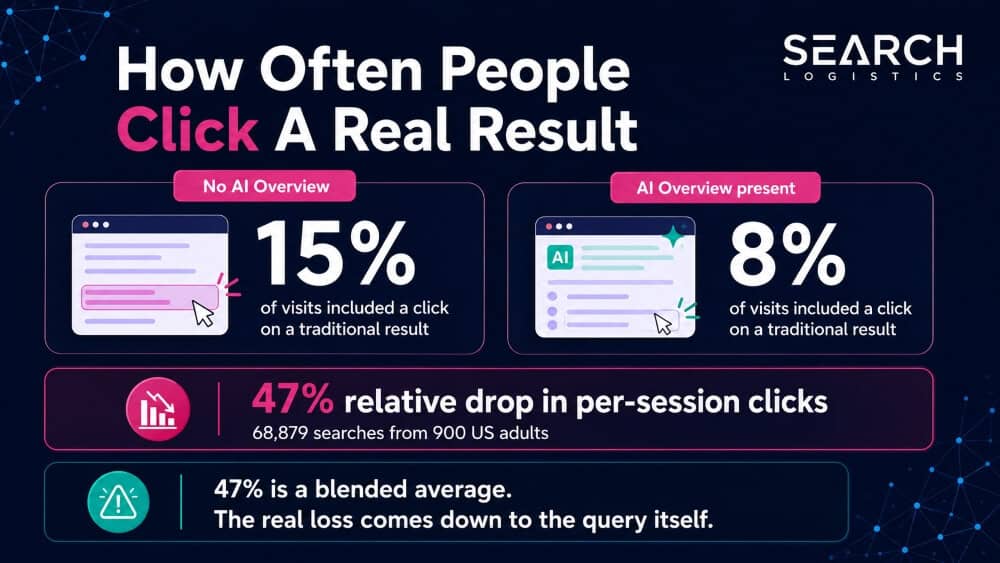
But keep in mind that 47% is a blended average – it mixes every type of search together.
Here’s the difference:
The real loss comes down to the query itself. Some queries lose far more clicks than others.
An informational query loses the most, because the AI can answer it directly and the searcher never needs to click.
A transactional or buyer query barely takes a hit, because the user still has to click through to actually buy.
Pro Tip: When you’re planning what content to create, don’t assume every query loses the same amount of traffic to AI Overviews. Target your bottom-of-funnel transactional queries first, then build the supporting topics around them to create topical authority.

How often do AI Overviews appear, and do people click sources?
AI Overviews are increasing on all searches.
But it’s affecting some types of queries and industries more than others.
How often do AI Overviews appear in search results?
AI Overviews appear on 20.5% of all Google searches.
This result comes from an analysis of 146 million search engine results pages on Google.
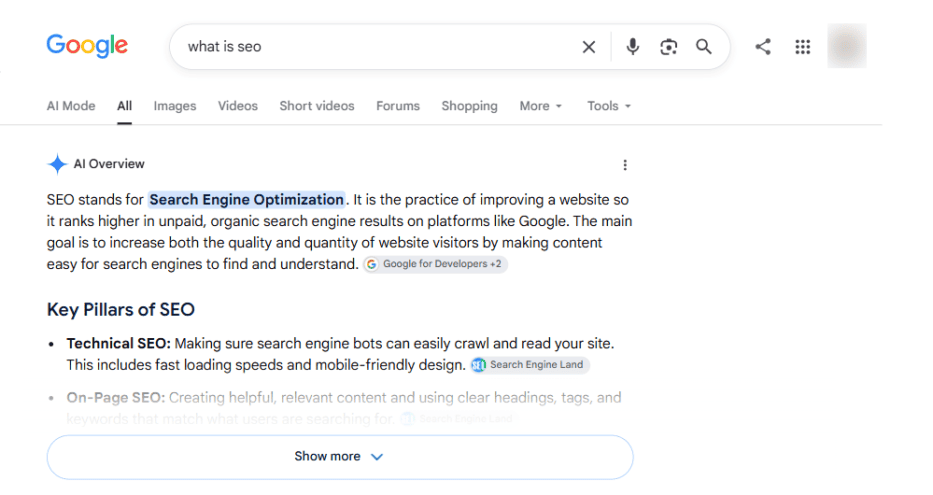
A separate study from Pew that tracked real user data found that AI Overviews appear on about 18% of all Google searches.
Both numbers show a consistent pattern that about 1 out of 5 searches tends to trigger an AI Overview.
But it’s not the same for all keywords…
Here’s the breakdown:
- Question-based searches trigger an AI Overview 57.9% of the time
- Ecommerce and shopping-based searches only trigger an AI Overview 3.2% of the time
- Navigational brand queries trigger the lowest amount of AI Overviews at just 1%
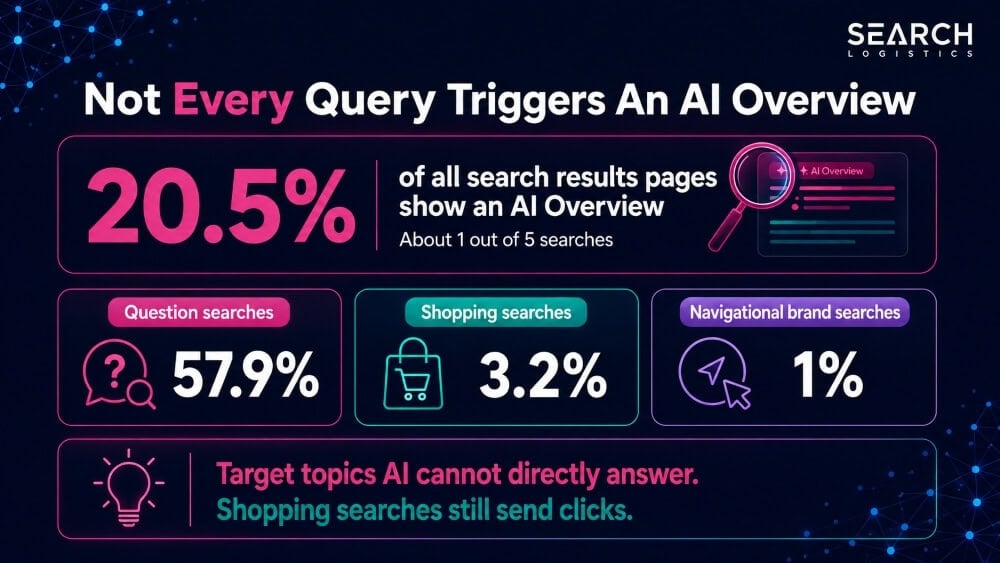
When choosing topics, think about queries that involve personal experience and expertise. AI Overviews are only increasing, so target topics that AI can’t directly answer or the user will naturally want a human reference.
The good news is that for shopping searches, AI Overviews appear very little.
This is why traditional organic ecommerce SEO has remained such a strong traffic source for online stores.
Do people click the sources cited in AI Overviews?
Yes, people do click the sources cited in AI Overviews. But the rate is significantly lower than Google’s traditional SERP rankings.
Just 1% of users click a link inside a Google AI Overview to visit an external website.
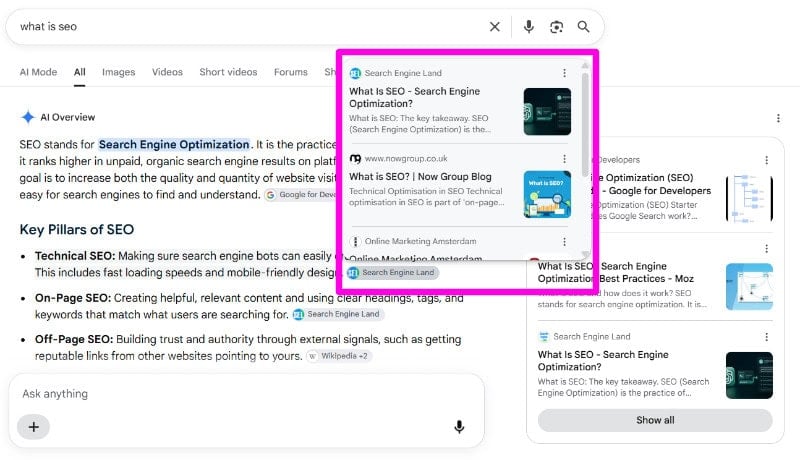
Compare that to the baseline 49% of searches that resulted in a click to an external website back before AI Overviews were launched.
Regardless of what Google claims…
AI Overviews read your page and summarise the answer for the user. They send almost zero traffic back to your site.
Short answer: No.
Keep in mind that if you sell the end product or service, a user will have to click through in order to purchase.
That’s why getting visibility in AI searches matters so much.
And that’s not all…
The data shows that being cited significantly beats out not being cited at all.
Brand-cited pages get 120% more clicks per impression than uncited pages that rank on the first page of Google but aren’t featured in AI Overviews.
In other words, if you rank on the first page of a Google SERP but aren’t featured in the AI Overview, you get significantly less traffic than the brands that get cited.
That’s why being cited matters. And it now potentially matters more than individual rankings.
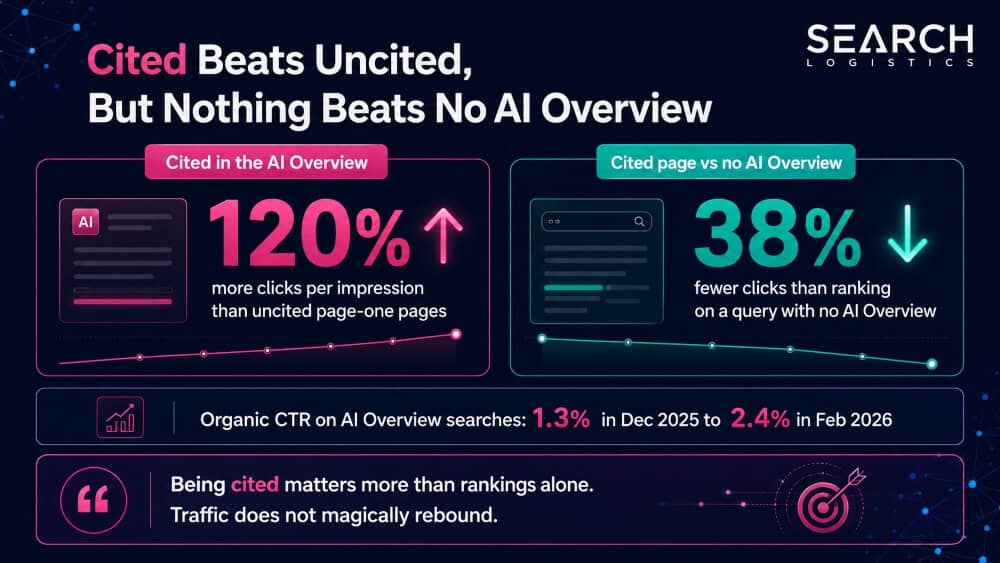
I don’t want to make it seem like being cited in AI Overviews fixes everything.
Cited pages get 38% fewer clicks compared to if they ranked for a search term that doesn’t show an AI Overview. Your organic traffic doesn’t just magically rebound once you’re being cited.
The good news is that organic CTR on searches that show an AI Overview increased from 1.3% in December 2025 to 2.4% in February 2026.
Our analysis of this data points more to the fact that organic CTR is flattening out versus increasing endlessly.
So I don’t recommend making forecasts or choosing new topics to cover based on this data alone.
Google AI Overviews vs Google AI Mode For Zero-Click Searches
Google AI Overviews are AI summaries that appear at the top of search results when someone types a query in Google.
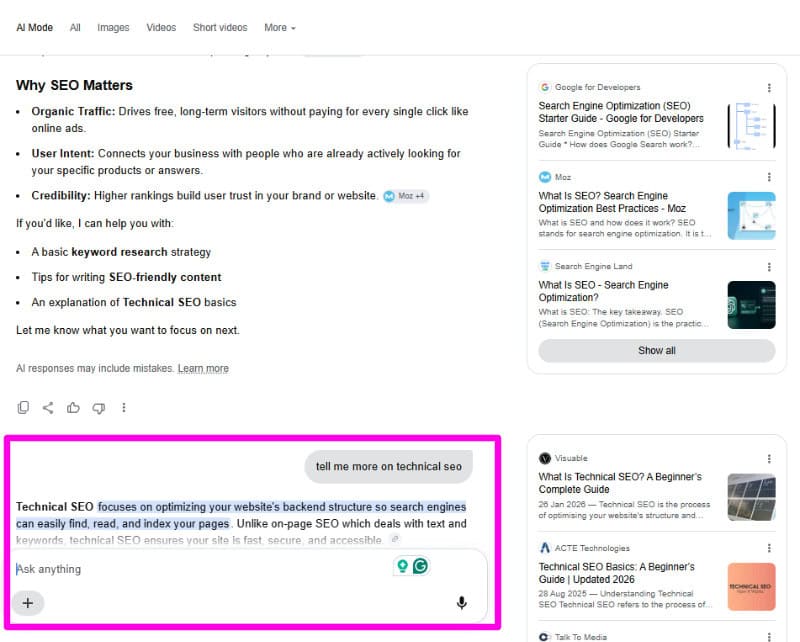
Google AI Mode is a dedicated AI chat interface that allows you to chat directly with the LLMs. AI Mode works very similarly to other AI chat platforms like ChatGPT and Claude.
Both Google AI Overviews and AI Mode are powered by Gemini.
What is the zero-click rate with an AI Overview versus AI Mode?
AI Overviews result in an average zero-click rate of 68% in the US, while AI Mode has an average 93% zero-click rate.
That’s a big difference.
The table below shows you the zero-click rate of Standard Google Search (before AI), Google AI Overviews and AI Mode:
| Google Search Type | Zero-click rate |
|---|---|
| Standard Google search | 49% |
| Search with an AI Overview present | 68% |
| Google AI Mode | 93% |
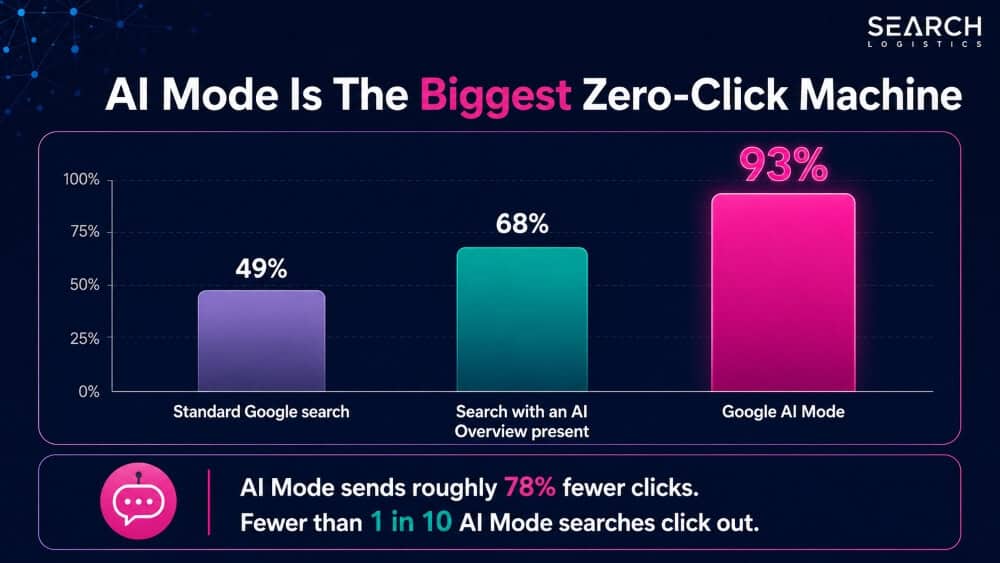
The biggest difference here is AI Overviews vs AI Mode.
Searches made in Google AI Mode send roughly 78% fewer clicks than AI Overviews do.
Think of this like this:
SERPs with Google AI Overviews result in about 3 out of 10 users clicking through to external websites. For AI Mode, less than 1 out of 10 searches results in a click to an external website.
That’s a significant difference.
Is AI Mode the same as AI Overviews?
No, AI Mode is not the same as AI Overviews.
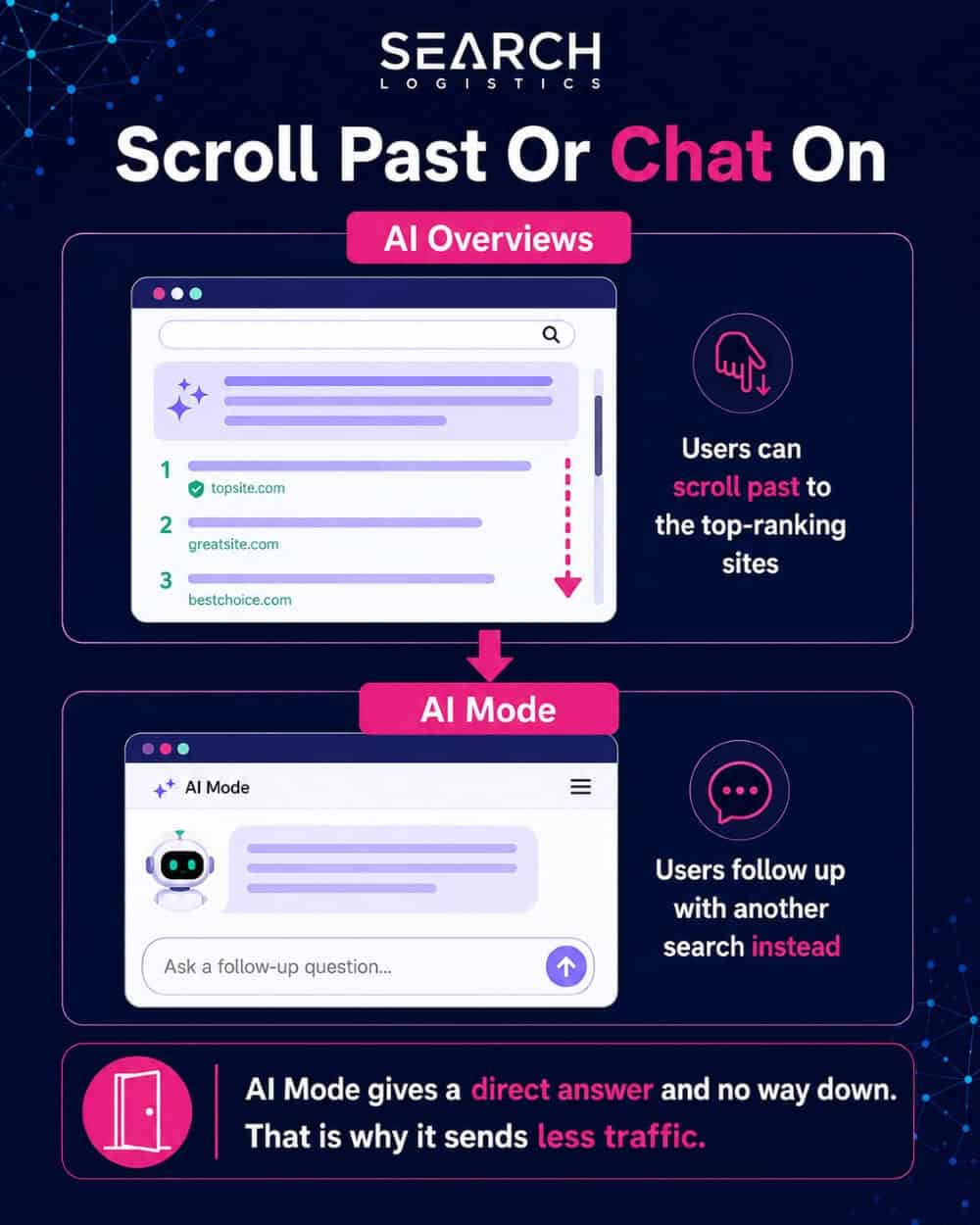
AI Overviews sit at the top of the SERPs, and users can still easily scroll past the AI summary to access the top-ranking sites.
AI Mode is its own tool with a chat-based interface. It scrapes the Google search results, finds sources to summarise and ultimately gives a direct answer to the user.
If the user isn’t satisfied with the AI answer in AI Mode, they tend to just follow up with another search. They can’t scroll down to the top-ranking results like they can with AI Overviews.
And that difference is why AI Mode sends less traffic to websites than SERPs with AI Overviews.
But here’s the interesting part…
AI Mode only accounted for 0.34% of all Google searches at the beginning of 2026. But Google has been pushing it hard.
Google AI Mode now reaches over 1 billion users per month. It’s become one of the biggest AI platforms in the world.
Keep in mind that AI Overviews reach over 2.5 billion people a month.
So Google AI Overviews has roughly 2.5x more users than Google AI Mode.
Where The Impact Of AI Overviews Varies For Zero-Click Rate
The impact of AI Overviews is not universal.
They affect some query types and industries more than others. Even the devices used to make searches end up impacting the zero-click rate.
Are zero-click rates higher on mobile or desktop?
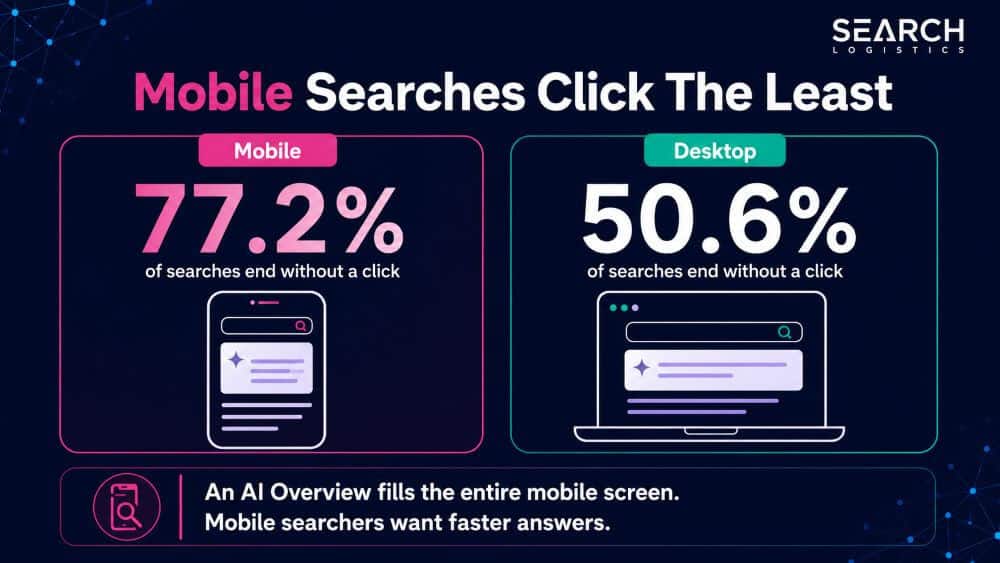
Zero-click rates are higher on mobile devices compared to desktop devices.
77.2% of all searches on mobile devices lead to zero-clicks, while only 50.6% of searches on desktop devices lead to zero-clicks.
Why is this?
Put simply: AI Overviews and general SERP features take up more of the screen on mobile devices.
An AI Overview on a mobile device takes up the entire screen. It also pushes the organic search results further down the page.
It’s also highly likely that when users search on a mobile device, they are looking for faster answers or results.
On a desktop, users tend to search slowly, which increases the chance of them clicking through to a website.
Which searches are most affected by zero-click?
The most affected queries by zero-click are informational and quick-fact search queries.
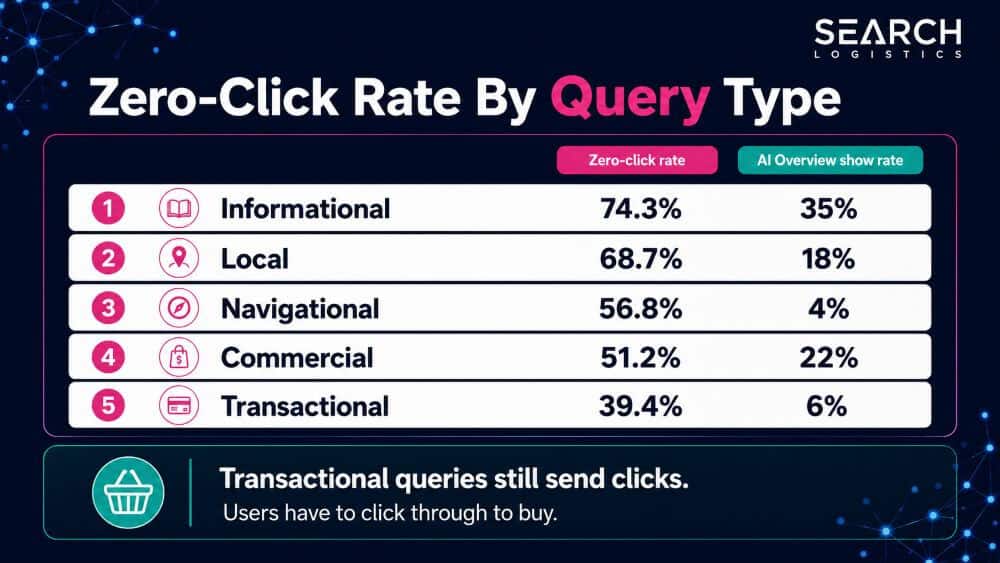
Informational queries now have a zero-click rate of 74.3%.
Here is the full breakdown of zero-click searches by query type:
| Query Type | Zero-Click Rate | AI Overview Show Rate |
|---|---|---|
| Informational | 74.3% | 35% |
| Navigational | 56.8% | 4% |
| Commercial | 51.2% | 22% |
| Transactional | 39.4% | 6% |
| Local | 68.7% | 18% |
Big difference, right?
What’s interesting is that transactional and commercial queries still have a strong click-through rate. That’s because users still need to click through in order to purchase a product or service.
And that’s not going to change anytime soon.
What matters is that your Google rankings for commercial/transactional searches and whether your brand is recommended when an AI Overview is triggered.
Does AI always increase zero-click searches?
No, AI doesn’t lead to an increase in zero-click searches.
Semrush tracked a batch of keywords that had no AI Overviews in May of 2025 but regularly started showing one 6 months later in October of 2025.
What was the result?
The average zero-click rate actually dropped a little bit rather than increasing. So an AI Overview triggering on a query does not automatically mean that the zero-click rate increases.
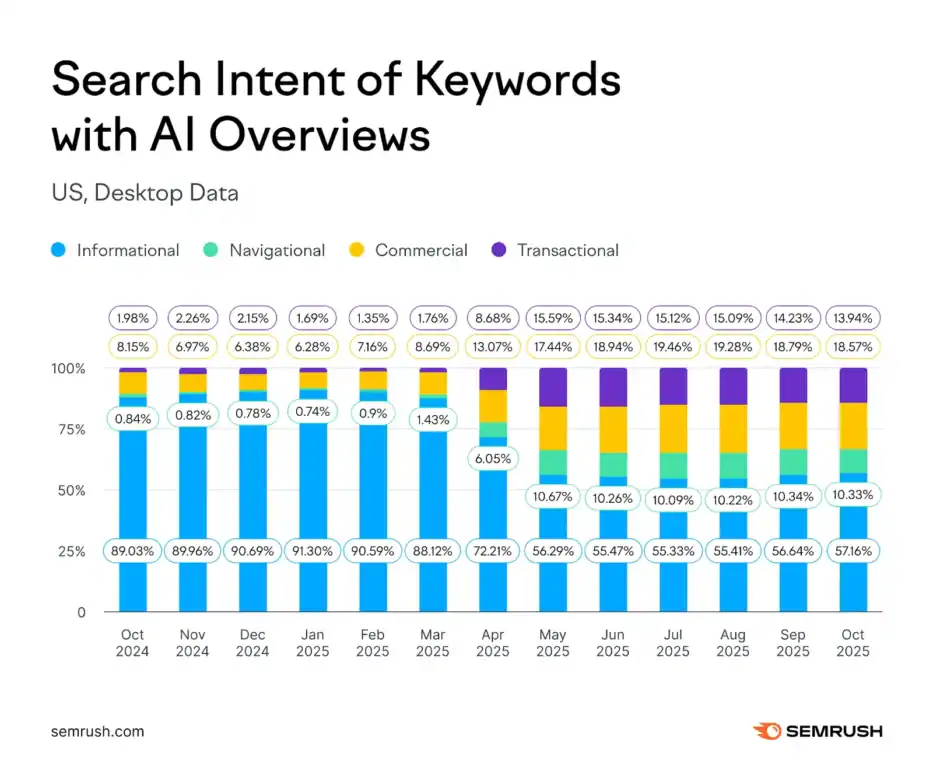
The truth is that some searches will never have a high click rate regardless of whether an AI Overview shows or not.
On the other hand, there will always be queries where the users want or need to visit the actual site. They’re the topics you want to rank for.
While the evidence is overwhelming in terms of showing that AI Overviews significantly increase zero-click rates, it’s not always the case.

Wrapping It Up
These zero-click search statistics all point to one conclusion…
The majority of Google searches now end without a click to a website. And that’s only going to increase over time.
Google AI Overviews reduce clicks by about half, and very few people click from chatbot interfaces like Google AI Mode.
What does that mean for SEO?
The truth is that SEO isn’t dying – it’s just changing.
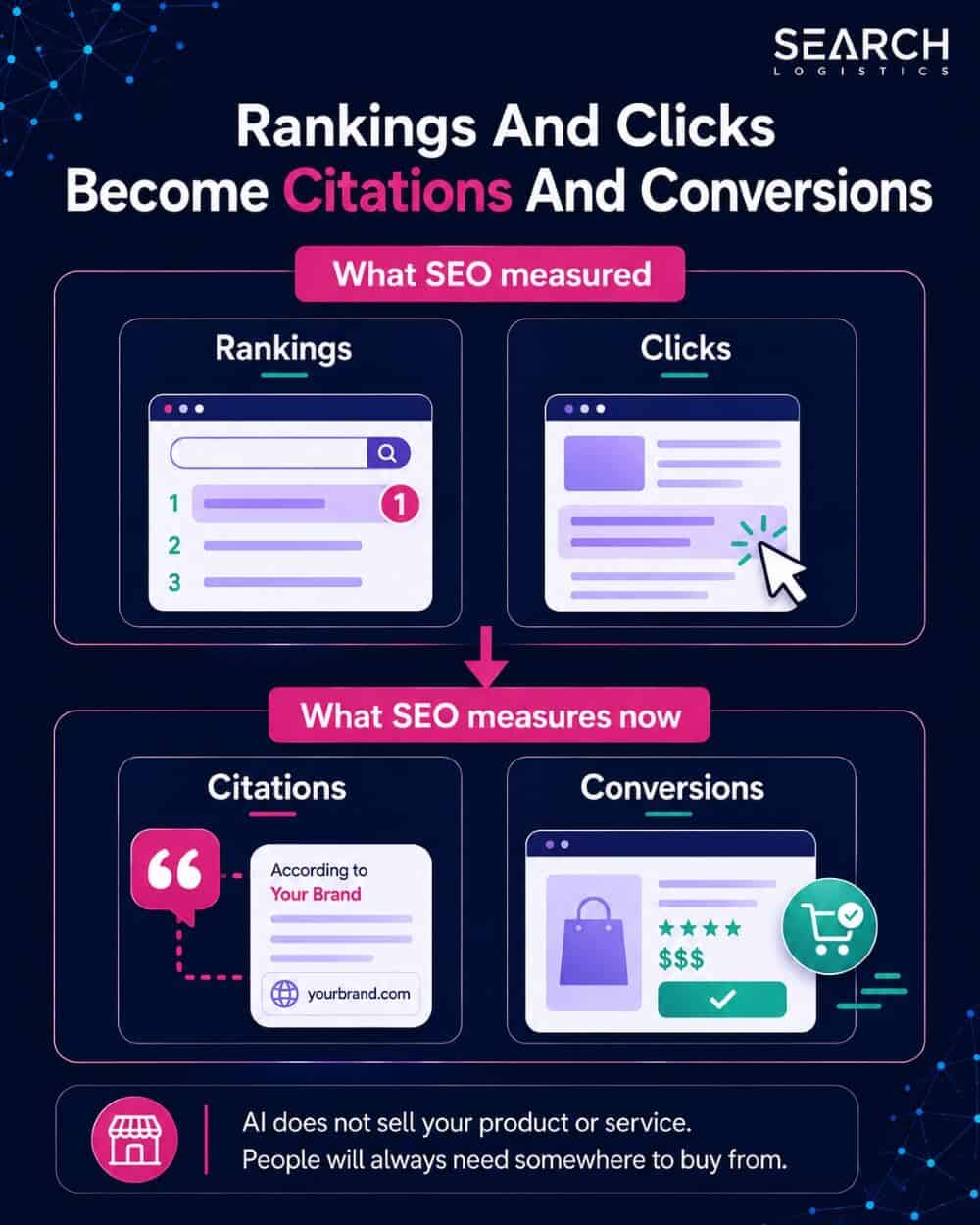
Rankings and clicks are slowly being replaced with citations and conversions.
Don’t forget:
AI can provide information. But it doesn’t offer the products and services that you sell. People will always search, and they’ll always need somewhere to buy from.
The difference is what websites are visible when those searches are made.
Your goal should be to gain as much AI visibility as possible and focus on converting AI referral traffic into customers. Simple as that.
Don’t spend your time chasing lost clicks. Focus on growing your business with AI search.

Frequently Asked Questions
You Might Also Like



What Are Your Thoughts?

 Subscribe to my YouTube
 Join My Facebook Group
 Connect on Linkedin
 Free SEO Tutorials
 SEO Case Studies
 Links That Rank