











































 Subscribe to my YouTube
 Join My Facebook Group
 Connect on Linkedin
 Free SEO Tutorials
 SEO Case Studies
 Links That Rank


SEO is not dead but search has fundamentally changed. With the introduction of AI search tools such as Google AI Overviews and LLM’s like ChatGPT, Perplexity, and Gemini, SEO is evolving quickly.
AI platforms now process millions of queries each day. That means SEO campaigns now need to include generative engine optimisation (GEO) and answer engine optimisation (AEO) techniques.
The reality is…
We are in a new era of search.
People have been predicting the end of SEO almost since it began.
And guess what?
SEO is still as strong today as it was 20 years ago.
BUT:
The game has changed.
37% of consumers start a search with an LLM instead of using traditional Google search.
What worked before doesn’t work anymore.
Don’t get left in the past and certainly don’t let people tell you SEO is dead.
So in this post, I will show you why “SEO is dead” claims are false and what you need to do to succeed with SEO today.

What Will I Learn?
SEO Is Not Dead But Evolving
Don’t believe everything you read about search engine optimisation being obsolete.
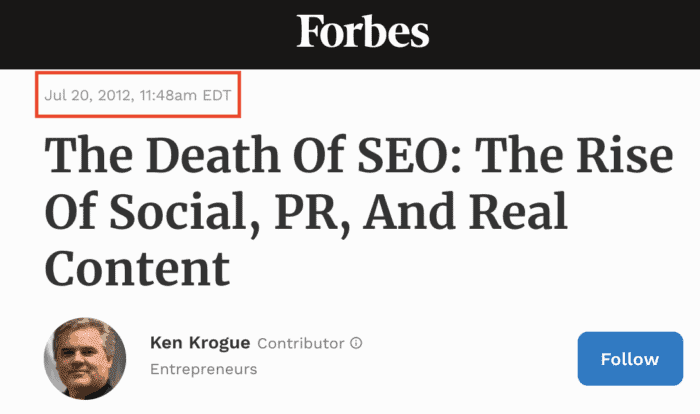
SEO will exist for as long as search engines do.
But SEO is an ever-changing industry that continues to evolve.
Because something works right now doesn’t mean it will work next month as search algorithms continue to change.
To be successful with your SEO strategy you need to:
-
- Embrace the change
- Adapt
With the reliance on AI and machine learning, search algorithms are changing at a faster rate than ever before. Each change requires you to adapt your content strategy so you can overcome each update.
This becomes even more important when optimising for AI search tools such as ChatGPT, Perplexity and Gemini.
The truth is that companies who have an established an answer engine optimisation (AEO) strategy capture 3.4x more AI search traffic compared to those that don’t.
Most people just can’t be bothered to keep up with each algorithm update and make the appropriate changes to their website.
They get lazy.
Here’s why that’s good news for you:
If you stay up to date with the latest Google changes and adapt your SEO strategies, you have the chance to continually improve your site performance while your competitors drop away.
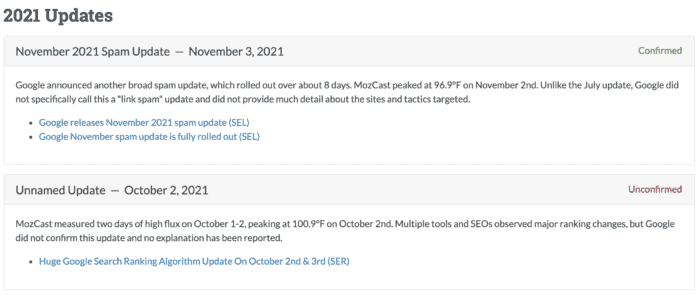
Over time your rankings improve and your organic traffic grows.

Why SEO Isn’t Going To Disappear Any Time Soon
SEO offers businesses the chance to appear in front of their ideal customers through organic search.
Who doesn’t want that, right?
But SEO offers more than that.
These are the three reasons why search engine optimisation is here to stay.
SEO Provides A High Return On Investment
Good SEO is ROI focused.
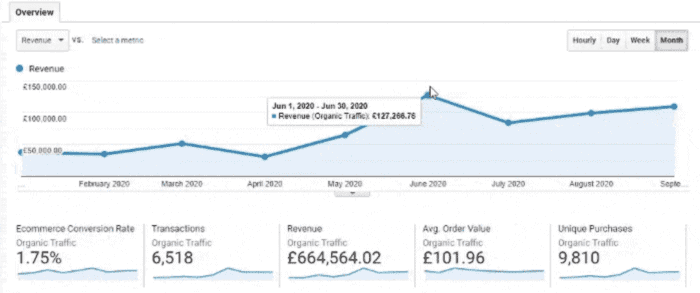
SEO provides one of the highest ROI’s of any digital marketing strategy available. And the results are long-lasting.
Check out this Ecommerce SEO case study to see exactly how my team tripled our client’s revenue with SEO alone.
Think about it:
When someone searches in Google they are actively looking for:
-
- An answer to their queries
- A specific product/service
If your website is at the top of the search results, they are likely to click on your site and purchase from you.
Compare that to paid advertising where the web traffic stops as soon as you stop paying. SEO is a compounding digital marketing strategy.
When done well you get more traction and better results over time.
This provides a much higher ROI for a more extended period.
SEO Is The Only Way To Get Consistent Targeted Traffic To Your Website
Let’s face it:
Online business is only getting more competitive with AI generated content and AI tools.
There is a lot of noise out there and getting enough visibility online is getting harder.
That’s where search engine optimisation shines.
SEO puts you in front of your target audience right at the moment they are searching for your products or services. And it’s consistent.
You are visible in the search results page 24 hours a day, 7 days per week.
Whenever your target audience searches, your website shows up in search engine results. This results in consistent quality traffic that increases leads and sales through organic search.
SEO Provides A Real Long-Term Competitive Advantage
SEO provides a competitive advantage that can’t easily be taken away.
If your competitor spends more than you with paid ads, they get all of the visibility and you miss out. That’s not the case with SEO.
SEO evens the playing field.

Ranking in the top positions is hard with AI overviews and featured snippets competition. But once you’re there it is equally hard for your competitors to rank higher than you.
This means that you will continue to get:
-
- Traffic
- Sales
… As a result of ranking.

5x Popular SEO Strategies That Are Dead Today
Here is a list of popular strategies that no longer work in search engine optimisation today.
If you search for SEO strategies online, you will undoubtedly find fake gurus promoting these exact traditional SEO strategies.
Don’t get caught up in the hype and avoid them at all costs.
1. Building A High Quantity Of (Poor-Quality) Backlinks
Link building is far from dead in digital marketing.
But building tons of low-quality links is dead.
Here’s what I mean:
Google has been after websites that build low-quality links in order to manipulate their algorithm for ages.
They have done a number of updates to counteract this in the past.
In August 2021 Google implemented a new link spam update.
This update was a new method for detecting dodgy links built by low-quality link building services.
Tons of websites using low-quality link building strategies took a huge hit in search engine rankings.

You are at risk if you’re still building tons of low-quality links to boost rankings. The link spam update means Google is actively hunting down sites that use this strategy.
Does that mean link building is completely dead?
Not at all!
Quality link building remains essential for both traditional SEO and GEO.
AI platforms such as ChatGPT, Gemini, Perplexity, Claude and Grok prefer to cite content from highly authoritative, well-linked sources. And it’s the same for Google.
In other words:
Link building is still one of the best SEO strategies you can use to dramatically improve your search results.
It just means that the link building game has changed to quality over quantity.
2. Over Optimisation For Target Keywords And Keyword Density
Keyword research and optimising your content for your target keywords are essential parts of search engine optimisation.
I mean you can’t build an SEO campaign without specific keywords, right?
But gone are the days when you can shove your target keywords into your content as much as possible and watch your search rankings skyrocket.
This infamous black hat strategy will land you in hot water.

Over optimisation or “keyword stuffing” is a huge deal to Google.
And their algorithm is very good at detecting when people are purposefully stuffing their content full of keywords.
I have seen tons of websites receive Google penalties because they over optimise their content with excessive keyword stuffing.
That is not a position you want to be in.
Been hit by a penalty? Check out my Google penalty recovery guide!
3. Creating A Lot Of (Low-Value) Content
Google loves unique content.
But what they really love is high quality content that serves their users in the best way possible. If you create low-value content, don’t expect it to rank.
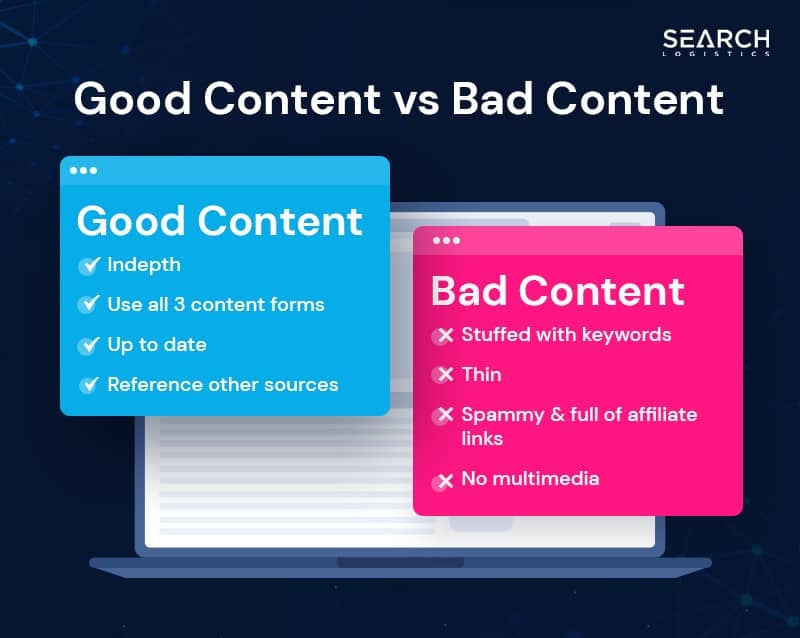
Low-value content is:
-
- Stuffed with keywords
- Thin and doesn’t satisfy user intent
- Offers little value
- Spammy & full of affiliate links
- Doesn’t include images or videos
Years ago you could hire a bunch of writers for $5 per article and just pump out tons of low-value content.

This strategy used to get you a lot of visibility and organic traffic. But now there is a lot of content online.
That means Google has tons of information to feed off.
What they are looking for is high quality content that will help their users.
Creating lots of low-quality content with very little value is a complete waste of time and money. You might even end up getting penalised long-term affecting your organic rankings.
4. Trying To Beat The Algorithm Instead Of Understanding It
I have met so many SEO’s and website owners who make this mistake in the SEO industry.
They think that SEO is like a competition between Google and them.
It’s a constant struggle to try and outsmart Google and manipulate the algorithm to boost rankings.

Don’t make this mistake.
Remember that Google’s search engine is a complex algorithm.
That means that it uses advanced mathematical equations to index and rank content.
If you feed those mathematical equations what it wants to see, your organic rankings will improve.
It’s as simple as that.
Think of your relationship with Google more like a partnership for your digital marketing strategy. You provide what Google wants to see and in return, you get more traffic and visibility.
That’s what I call a win-win.
5. Focusing On The Algorithm Instead Of The User
The core goal of Google’s algorithm is to help people find what they are searching for.
Their written mission statement is:
“organize the world’s information and make it universally accessible and useful”.
What does that mean for you and your SEO strategy?
Google is focusing on helping its users and you should be too. They want their users to have the best search experience possible.
In September 2021, Google rolled out a new page experience update affecting page speed optimisation.
The whole goal of this update was to prioritise websites that provide a good user experience for their visitors through enhanced search results.
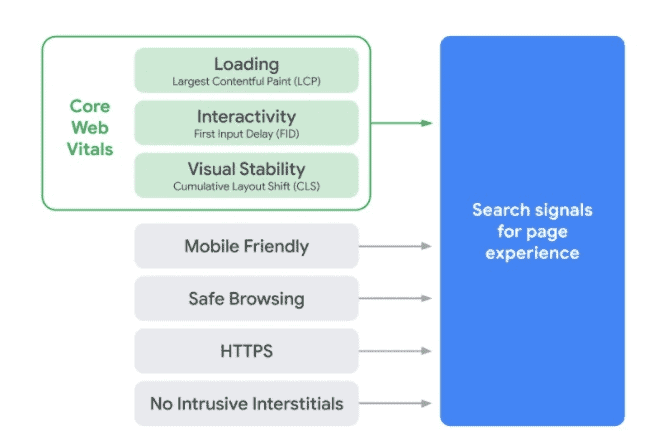
If you missed it, follow this Google page experience update checklist to ensure you are ahead of the update.
It covers important page experience metrics like how to improve core web vitals and page speed.
The truth is page experience is here to stay.
Focus on providing a good user experience to your audience and this will naturally make the algorithm happy as well.

6x SEO Strategies That Are Still Working And Rocking
What about SEO strategies that work today in the current search experience?
I’ve got you covered. Use any (or all) of these 6 SEO strategies to improve your search engine optimisation.
1. Creating Killer Website Content That Satisfies User Intent
76% of sources cited in Google AI Overviews rank in the top 10 search results.
This proves that high-quality, well-optimised content remains the foundation for both:
-
- Traditional search visibility
- AI search visibility
In other words:
The number 1 way to improve your SEO is to write high-quality website content that satisfies user intent.
Google loves unique content that is in-depth and up to date.
More importantly, your audience does too.
This means that killer content creation is less about writing and more about providing tons of value to your audience.
So how do you create killer website content?
Good content starts with research using analytics tools.
You need to understand what issues your audience is facing and what they want to read about.
Once you know that, you can start to put together topics to write content about.
When you write content follow these SEO writing tips:
-
- Write exactly as you speak with conversational keywords
- Produce comprehensive long-form high quality content
- Make your content skimmable with subheadings for better user experience
- Don’t write large chunky paragraphs
- Add videos and images for visual search optimisation
Ensure that you only add your target keywords within content where they naturally fit. Avoid keyword stuffing and over optimising your keyword density.
Check out these SEO copywriting hacks to learn how to create content that keeps your audience engaged and ranks in Google.
Pro tip: You can also use AI tools like Frase to speed up your content production process and create content faster.
2. Promoting Your Content On ALL Your Channels
I have said it before, I’ll say it again…
“Spend less time on content creation and more time on content promotion.“
This is the biggest crime most content creators make.
They spend all of their time constantly writing new pieces of content and not enough time putting their content in front of their audience on social media.
Your goal is to get eyes on your website and attract traffic. You need to spend time actively promoting each piece that you write.
How do you do that?
Create a content marketing strategy that uses social media effectively.
A content promotion strategy doesn’t mean buying tons of ads on Facebook and Google. A powerful promotion strategy doesn’t even involve spending any money on ads.
Make sure that you are active on social media channels where your audience hangs out.
Engage with other influencers in your space and see how you can collaborate with each other.
You can even join niche forums and get involved in the conversations.
This is the secret of getting more website traffic without burning yourself out by creating new content all the time.
Word of caution: Don’t spam your content at every opportunity you get on social media. This will only annoy people.
Instead focus on helping others and reference your content when it’s appropriate.
3. Focusing On Topic Research Over Keyword Research For Better User Intent
Keyword research is an essential part of any SEO and digital marketing strategy.
It has the power to generate thousands of website visitors to your website when done correctly. But get it wrong and you might as well not bother.
One of the biggest keyword research mistakes I see is people targeting a wide variety of search terms.
They do this because they are totally fixated on individual keyword search volumes
This leads to sporadically creating content across lots of different topics without considering niche relevance and topical authority.
Google only ranks content that satisfies the E-E-A-T metrics:
-
- Experience
- Expertise
- Authoritativeness
- Trustworthiness

How do you best satisfy these metrics?
Create content around whole topics focusing on user intent and covering those topics completely.
This has heaps of benefits for your SEO performance:
-
- Creates relevance within your website content
- Keeps visitors on and moving around your site
- Makes you the authority on the topic
- Satisfies Google’s algorithm
Whenever you are doing keyword research start with topic research first.
Once you have zeroed in on a couple of relevant topics, you can find the specific keywords within that topic.
This will make you the trusted expert for each topic your cover and ultimately lead to more SEO traffic.
4. Keeping Your Content Up To Date And Reusing It
Most people create content, post it, and never touch it again.
What happens is your content ranks for a while but as it becomes outdated, Google starts to rank your competitors’ more recent content and slowly relegate yours to the bottom of the search results.
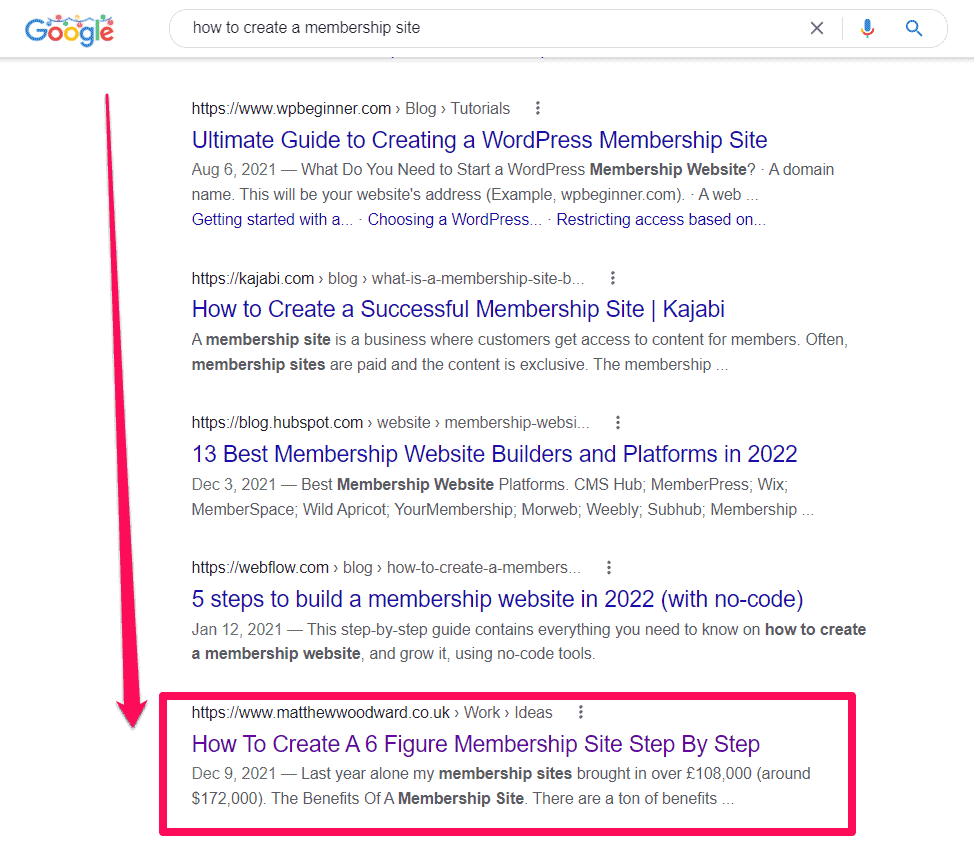
The next thing you know your web traffic has dropped off completely.
Creating fresh content is good, but it’s also time-consuming.
Your goal should be to create evergreen content and then continue to update it as needed.
This is how you create a scalable content strategy that improves SEO and drives more web traffic to your website over time.
How do you keep content updated?
Set up a reminder every 6-12 months that reminds you to go back and update your older posts.
This does two really good things:
- Allows you to update your content with new insights
- Gives you the updated date in the search results


I have a piece of content that I published 4 years ago. Because I update it regularly it has remained at the top of the search results for 4 years.
Pretty good, right?
I use Surfer SEO to keep my posts up to date and monitor AI search results.
It analyses the top search results for my target keyword and highlights areas where I can improve my content.
Check out my complete Surfer SEO review to see how to use it.
5. Running SEO Audits Regularly With Analytics Tools
Seen a drop in traffic?
You need to run SEO audits consistently – about every 3 months using analytics tools.
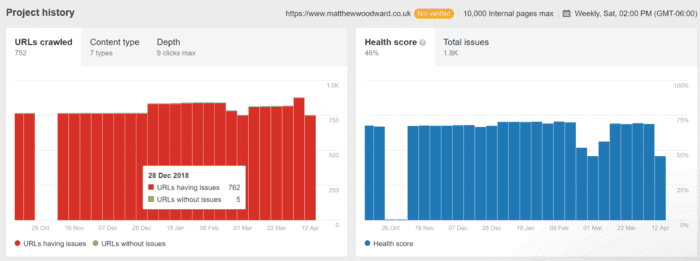
Here’s why:
As your website grows and you publish more content, SEO issues will occur affecting your website’s visibility. These issues usually fly under the radar until one day – your organic traffic suddenly drops off.
The only way to protect against these issues is to regularly run SEO audits on your website.
This ensures that you get on top of any issues before they affect your search rankings.
Running audits doesn’t have to be complicated.
Just follow my 5 step SEO audit to quickly get an overview of your SEO health and diagnose any immediate issues.
Interested in SEO audit? Check out my 4 step SEO audit results including key takeaways SEO professionals need!
6. Work On Making Your Site Is Not Only Google-Friendly But Also User-Friendly
Your website should always be user-focused first to improve search results.
This means it’s critical to ensure that your website-
-
- Loads fast
- Is mobile responsive
- Has good core web vitals
- Is easy to navigate
- Has excellent on-page SEO
40% of people won’t wait more than 3 seconds for your website to load.
That means that if your website takes longer than 3 seconds to load, you automatically lose 40% of your traffic.
That’s a massive chunk of web traffic to lose.
Use the Google PageSpeed Insights tool to ensure that your website has a perfect Google PageSpeed score.

You also need to make sure that your website has excellent on-page SEO and proper content optimisation.
Lots of people underestimate the power of on-page SEO.
Don’t get caught in this trap.
Spend the time to get your on-page SEO right.
If you’re struggling, feel free to use:
-
- My on-page SEO checklist for content optimisation
- My complete SEO checklist covering all SEO strategies
You will be surprised how much of a difference it will make to your search rankings and AI search visibility.

Wrapping It Up
Here’s the big takeaway:
SEO strategies will continue to change as algorithm updates are rolled out, but search engine optimisation will always exist in some form.
Don’t get swayed by people saying ‘SEO is dead’.
Now is the time to focus on your SEO.
Get ahead of the algorithms by using the 6 SEO strategies above that still work well today even with AI Overviews and AI search.
The ROI that SEO can bring to your business will be the basis of consistent growth for years to come!

Frequently Asked Questions
You Might Also Like




What Are Your Thoughts?
2 Responses



Yes, SEO is dead. Many SEOs are complaining about indexing problems. crawlers don’t come on websites. many problems facing SEOs.
Interesting point of view! I kind of disagree, though. I think SEO is evolving, not dying. SEOs need to keep up with all the changes and update their methods/techniques…